


State Hospital Admission Region Alignment
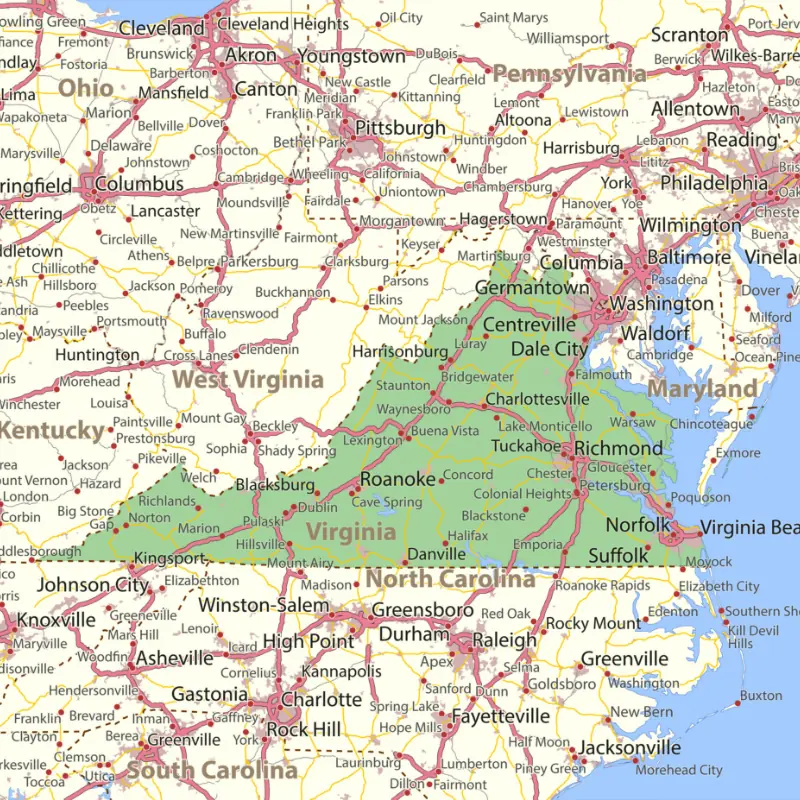
DBHDS has developed a proposal for more predictable geographic service areas, or “home hospitals,” for Virginia’s state mental health hospitals. The proposed alignment is intended to better match hospital capacity with demand, reduce extreme cross-state transports and strengthen coordination between community services boards, law enforcement and state hospitals.
DBHDS will update the information as discussions and implementation planning continue.
Why DBHDS is making this change?
Since 2021 during the pandemic, capacity pressures and bed closures have required a centralized statewide admission process. Individuals may be admitted wherever a bed is available, sometimes several hours from their community. Those trips place a burden on law enforcement and can make it harder for families to participate in treatment and recovery. Most CSBs statewide have been asking for a return to the previous regional structure that allowed the state hospital and local CSB and law enforcement to work more closely together to manage state hospital admissions and discharges.
However, historical service areas do not consistently match current demand or available capacity. DBHDS reviewed FY2025 and FY2026 adult civil bed use, excluding maximum-security admissions, and considered geography, drive times and hospital operations in developing the proposed alignment. The presentation linked below explains the analysis.
What does “home hospital” mean?
A home hospital is the designated state hospital that a CSB would routinely work with on admissions, treatment and discharge planning. More consistent working relationships can strengthen coordination and support transitions back to the community.
Centralized admissions would continue. The designated hospital is not a guarantee of placement. Capacity, clinical needs, urgency and required admission timelines may still require admission elsewhere.
What does this mean for local communities?
Across adult and geriatric assignments, 12 of Virginia’s 40 CSBs would have a designated home hospital change. Eleven would have an adult change and six would have a geriatric change. Five CSBs are in both groups. Region Ten’s change is geriatric only.
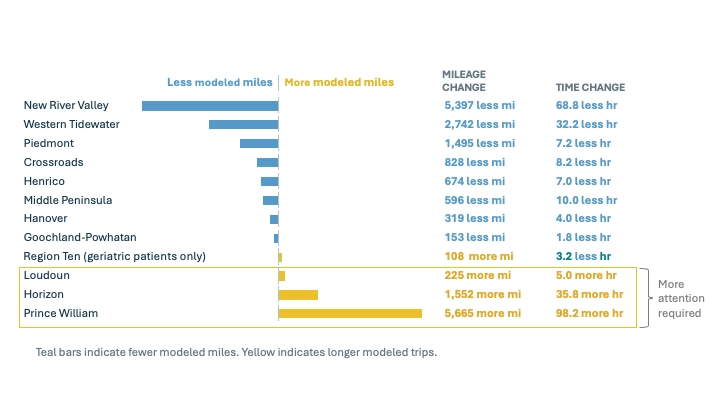
Some designated trips would be longer. DBHDS recognizes the impact on officers, individuals receiving care and their families. The statewide goal is to reduce the frequency of much longer, unpredictable diversion trips. The materials below show the specific changes and current diversion patterns for each affected CSB.
Local Mileage Impacts for the 12 Changing CSBs
28 of Virginia’s 40 CSBs will experience no change to their designated hospital. For 12 CSBs, some designated hospital trips would become longer. However, the proposal is intended to make transport destinations more predictable and reduce the frequency of much longer cross-state diversion trips.
| CSB | Admission population | Current designated hospital / drive time | Proposed designated hospital / drive time | More distant diversion destination / drive time | FY26 diversion rate |
| Crossroads | Adult | CSH / 1.25 hours | WSH / 2 hours | SWVMHI / 3.5 hours | 95% |
| Goochland-Powhatan | Adult | CSH / 1 hour | WSH / 1.5 hours | SWVMHI / 4 hours | 50% |
| Hanover | Adult | CSH / 0.75 hours | WSH / 1.75 hours | SWVMHI / 4.25 hours | 90% |
| Hanover | Geriatric | PGH / 1.25 hours | ESH / 1 hour | SWVMHI / 4.25 hours | 50% |
| Henrico | Adult | CSH / 0.75 hours | WSH / 1.75 hours | SWVMHI / 4.25 hours | 88% |
| Horizon | Adult | WSH / 1.5 hours | SWVMHI / 3 hours | NVMHI / 3.5 hours | 40% |
| Horizon | Geriatric | CAT / 1.5 hours | PGH / 1.25 hours | ESH / 3 hours | 33% |
| Loudoun | Adult | NVMHI / 0.75 hours | WSH / 2.5 hours | SWVMHI / 5 hours | 42% |
| Middle Peninsula | Adult | ESH / 1.25 hours | WSH / 2.5 hours | SWVMHI / 5 hours | 100% |
| Middle Peninsula | Geriatric | ESH / 1.25 hours | PGH / 2 hours | SWVMHI / 5 hours | 100% |
| New River Valley | Adult | SWVMHI / 1.25 hours | CAT / 1 hour | NVMHI / 4.25 hours | 96% |
| Piedmont | Adult | SVMHI / 1 hour | SWVMHI / 2.25 hours | NVMHI / 5 hours | 57% |
| Piedmont | Geriatric | CAT / 1.5 hours | SWVMHI / 2.25 hours | ESH / 4 hours | 0% |
| Prince William | Adult | NVMHI / 0.75 hours | WSH / 2 hours | SWVMHI / 4.75 hours | 20% |
| Region Ten | Geriatric | PGH / 1.75 hours | CAT / 2.25 hours | SWVMHI / 3.5 hours | 6% |
| Western Tidewater | Adult | ESH / 1.25 hours | SVMHI / 3 hours | SWVMHI / 5.75 hours | 100% |
| Western Tidewater | Geriatric | ESH / 1.25 hours | PGH / 2.25 hours | SWVMHI / 5.75 hours | 92% |
Understanding the Transportation Data
Drive times are estimates from the primary CSB office to the hospital. Travel from a particular locality may differ. Return travel and the admission handoff add to the time an officer is away from local duties.
The FY2026 diversion rate is the percentage of civil admissions in the indicated age group admitted outside the designated state hospital. It does not show how many went to the more distant hospital listed in the table. These figures describe prior admissions; they do not predict the destination or travel time for an individual admission.
Questions and Next Steps
Local meetings and next steps
DBHDS is arranging meetings for each of the 12 affected CSBs with CSB leadership, local law enforcement, affected General Assembly members and receiving hospital leadership. The meetings will review the statewide rationale, local data and operational concerns.
Participants will receive the presentation, a summary of questions and next steps, and contacts for follow up. Questions requiring additional review will have an assigned response date. Members and officers are welcome to contact DBHDS during the process.
January 1, 2027, is the target implementation date, subject to completing engagement and final approval. DBHDS will post confirmed assignments, dates and operating guidance before implementation. The current timeline will be available here.
Frequently Asked Questions
Will an individual always go to the designated home hospital?
No. Centralized admissions will continue to address available capacity, clinical needs, urgency and required timelines. Placement elsewhere may still be necessary.
Will every jurisdiction have a shorter trip?
No. Some designated hospitals would be farther away. DBHDS will discuss those local impacts directly. The intended statewide benefit is fewer extreme cross-state diversions and more predictable working relationships.
How will DBHDS use the concerns raised in meetings?
DBHDS will review local transportation, admissions and coordination concerns as implementation is planned. Follow up will explain the response, any resulting adjustments and questions still being resolved. Common questions will be added to this page.
Where can I find the latest information?
Use this page for the current fact sheet, presentation, local changes, timeline and FAQ. Check the last updated date at the top of the page and the date on each document.
Contact
For routine questions, contact Suzanne Mayo, Assistant Commissioner for Facility Services, at Suzanne.Mayo@dbhds.virginia.gov.
For significant concerns about the proposed alignment or issues requiring senior level resolution, contact Commissioner Daryl Washington at Daryl.Washington@dbhds.virginia.gov.